Pieter Levels: The Man Who Built a $3M Empire from a Spreadsheet

In 2014, a Dutch music producer sitting in a cheap apartment in Bangkok made a public promise that would change how thousands of people think about building products.
He was broke. His music career had stalled. He’d had a taste of freedom — travelling through Asia, working online — and now he was watching it slip away as his bank account drained. He needed to make money. And he needed to make it fast.
So he opened his laptop and told the internet he was going to build 12 startups in 12 months.
That person is Pieter Levels.
Who is Pieter Levels?
Born in Amsterdam in 1987, Pieter Levels studied music production at the Conservatorium van Amsterdam and worked as a techno music producer and DJ before becoming an entrepreneur. He taught himself to code in his late twenties — no computer science degree, no bootcamp, no formal training.
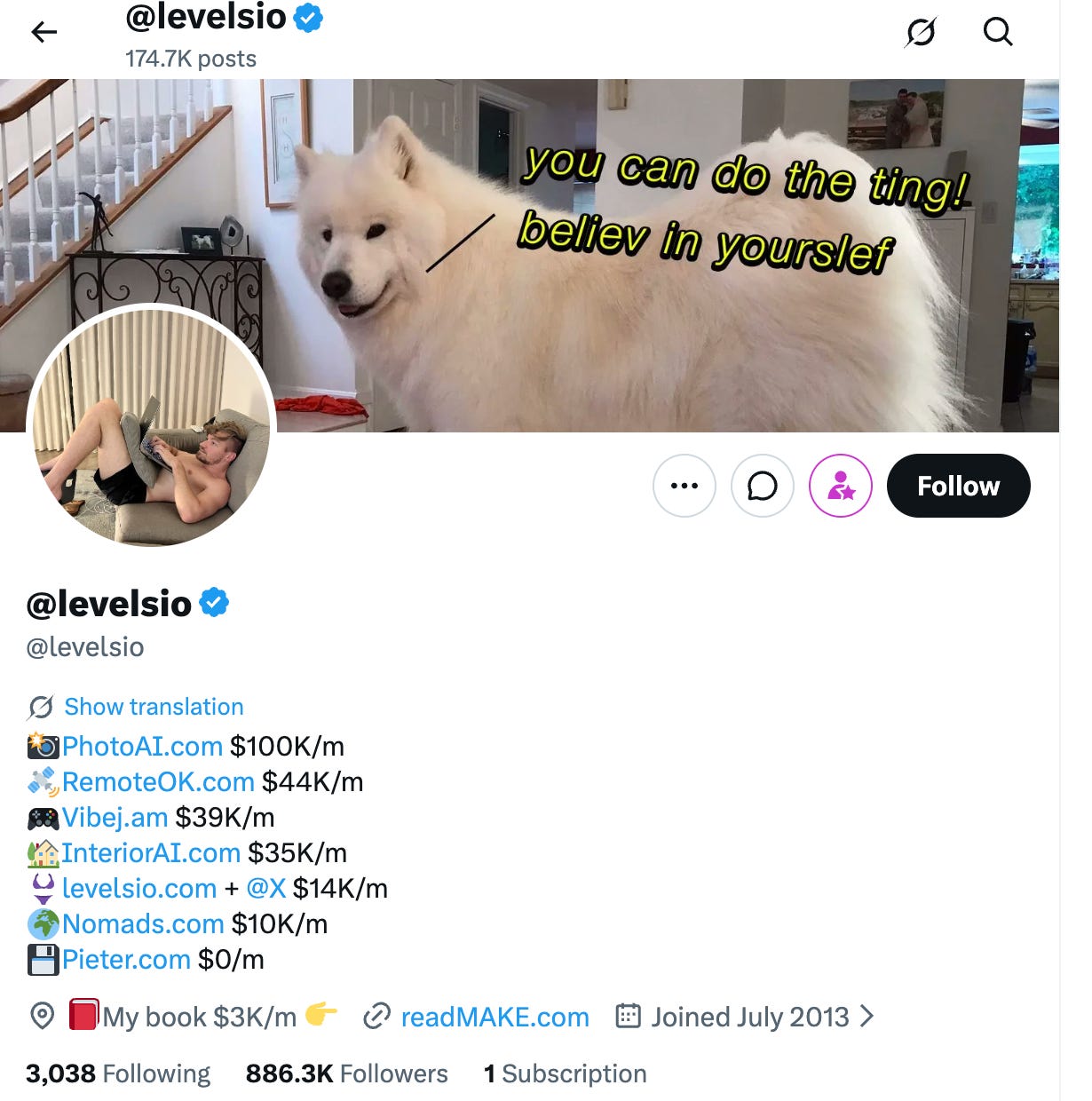
Today he is one of the most well-known indie makers in the world. He has built a $3.1M per year portfolio of bootstrapped products — including Nomad List, Remote OK, and PhotoAI — without funding, employees, or an office. He has over 500,000 followers on X where he shares everything — revenue numbers, failures, experiments, and ideas — in real time.
He is, more than almost anyone else, the person who made “one person, one laptop, real business” feel possible.
This is how he got there.
The challenge
The rules he set himself were brutal in their simplicity: one new product, every month, for 12 months. Ship it. Launch it. Move on. No exceptions.
He wasn’t trying to build 12 successful companies. He was trying to find out which ideas had life in them by putting them in front of real people as fast as possible. Most would fail. That was fine. Failure at speed costs almost nothing. Failure after six months of building costs everything.
Project number seven was a spreadsheet.
He had a question he couldn’t answer: where in the world is the best place to live and work as a digital nomad? So he built a public Google Sheet ranking cities by cost of living, internet speed, weather, and safety. He shared it on Twitter.
The internet lost its mind.
From spreadsheet to $3M
Within days, the spreadsheet had more traffic than he knew what to do with. People were sharing it, adding to it, arguing about which cities deserved their rankings. He had touched something real — a question thousands of people were quietly asking with no good answer.
Over the next months, the spreadsheet became a website. The website became a paid membership community. The community became the largest crowdsourced database of cities for remote workers in the world, with over 100,000 members.
He built all of it alone. His tech stack was vanilla PHP, jQuery, and SQLite — not React, not microservices, not the cutting-edge frameworks developers spend months debating. Just simple tools, used well, by one person who cared more about shipping than impressing.
Meanwhile he launched Remote OK — a remote jobs board built inside a single PHP file — which grew into the world’s largest platform of its kind. Then PhotoAI, an AI image generation tool, which became profitable within weeks of launch.
The combined result: approximately $3 million per year in revenue. Profit margins above 90%. Zero employees. Zero investors. Zero office.
Thanks for reading Behind's Substack! This post is public so feel free to share it.
The real story behind the numbers
When people discover these numbers, the first instinct is to look for the trick. The famous audience that explains it. The lucky timing. The viral moment that made it easy.
But Pieter has been consistent about what actually happened: it took over 70 attempts, not 12. Years of shipping things that went nowhere. Nomad List wasn’t a stroke of genius — it was the seventh thing he tried in a year when he was running out of money and desperately needed something to work.
What separated him from the thousands of developers who tried the same 12-startups challenge and disappeared wasn’t talent or luck. It was one decision he made from the very beginning: to build everything in public.
He shared his revenue numbers openly. He wrote about what was working and what wasn’t. He made his entire business — the good months and the terrible ones — an open book on Twitter.
That transparency became his most powerful growth engine. Every honest post about a struggle built trust with people who would eventually become customers. Every revenue milestone he shared brought thousands of curious builders to discover his products. He didn’t build an audience to sell to. The audience found him because of how he built.
We tell one founder story every week. Some are famous. Most aren’t yet. All of them are honest.
One founder. One story. Every Sunday. That's the promise.
Three things he did that most founders won’t
He shipped before it was ready. Nomad List was a spreadsheet. Remote OK was a PHP file. PhotoAI was an experiment. None of them were polished at launch. He put the simplest possible version in public and let real users pull it forward. The version in your head is not the version that succeeds — only the version people can actually use tells you anything true.
He built for himself first. Every product he’s built started as something he personally needed. That’s not a coincidence — it’s the source of the authenticity that made early users trust him. When you’re solving your own problem, you know exactly how good the solution needs to be.
He made transparency his competitive advantage. In a world where most founders only share the wins, Pieter shared everything. The struggles. The near-failures. The experiments that went nowhere. In doing so he built something most funded startups spend millions trying to manufacture: genuine trust.
Where he is now
He recently built an AI flight simulator in 30 minutes using Cursor. It went viral. He added a Stripe payment link for pixelated F-16 jets. It started making money within days.
The 12-startups challenge he started in 2014 has now been attempted by thousands of builders worldwide. Most don’t complete it. But the ones who get somewhere tend to share one thing in common — they stopped waiting for the right moment and started shipping.
Pieter Levels never waited. That’s still, a decade later, the whole story.
Pieter writes at levels.io and shares everything at @levelsio on X. His book MAKE — about bootstrapping startups without funding — is at makebook.io.
What founders can learn from Pieter Levels
Build in public. Transparency isn’t a strategy — it’s how trust compounds. The audience finds you because of how openly you build.
Ship before you’re ready. The perfect product in your head has zero users. The ugly version in public teaches you everything.
Solve your own problem. You can’t fake knowing your user when you are your user.
Volume beats perfection. It took 70+ attempts, not 12. Failure is cheap information — treat it that way.
Simple tools, used consistently. Vanilla PHP still powers Nomad List a decade later. Boring and reliable beats cutting-edge and complex.
Turn constraints into speed. No team. No investors. No office. Every limitation became an advantage because he never waited for ideal conditions.
If someone you know is building something worth featuring — comment on this post. I read every comment. :)