How to Get Free Backlinks for Your New Website (+Checklist)

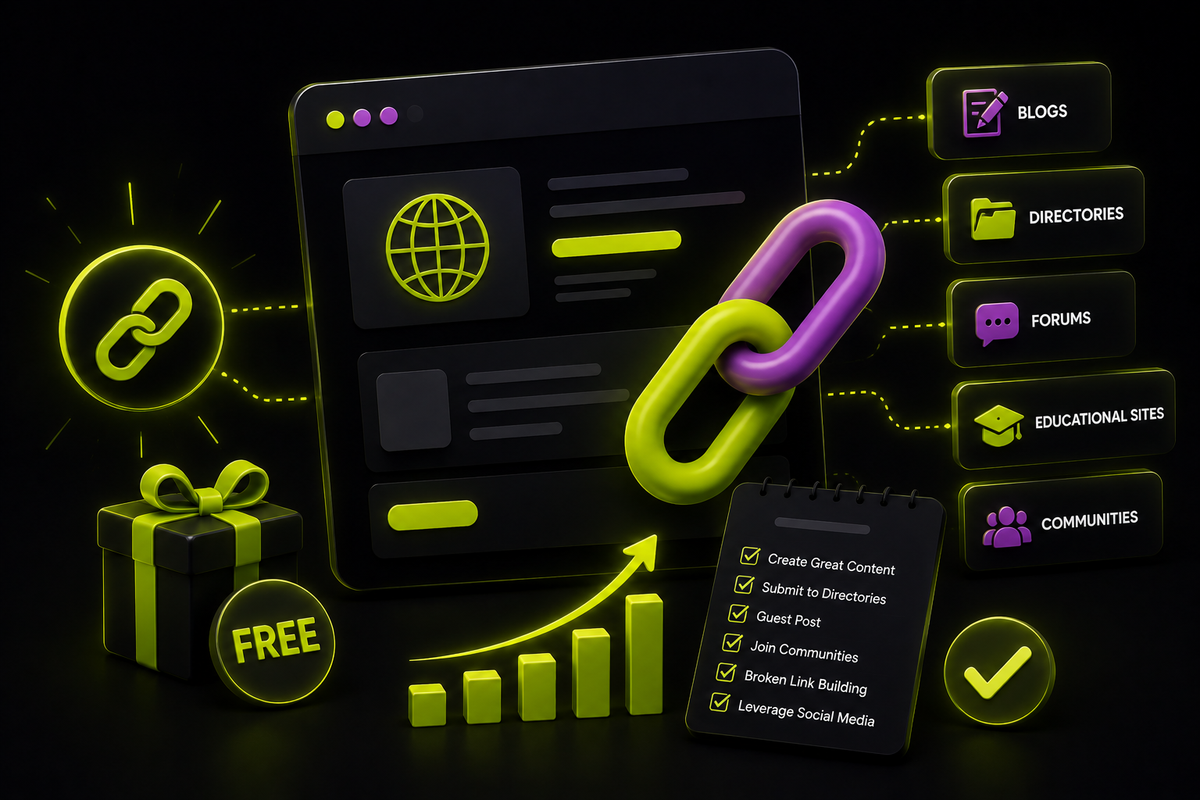
If you know anything about ranking a website on Google and other search engines, you must be aware of backlinks and their importance.
For a brand-new website, that second stat matters more than anything else in this article. You don't need thousands of links. You need to go from zero to a handful of relevant ones, and that alone puts you ahead of the vast majority of pages competing for the same keywords.
If you're wondering how to get free backlinks without paying for expensive outreach tools or agencies, this guide is for you. We'll walk through exactly how to build backlinks for free, starting with the tactics that work even when your site has zero history and zero relationships.
TL;DR
- Backlinks still matter. A site with even one backlink outperforms one with none by a wide margin, you don't need thousands to see results
- Start with zero-effort tactics: startup launch platforms (SuperLaunch, Product Hunt), business directories (Crunchbase), and web 2.0 platforms (Medium)
- Move into outreach once you have a few links: guest posts, testimonials, broken link building, digital PR (Connectively, Qwoted)
- Build things that earn links passively: free tools, original research, resource page listings
- Reclaim what you already have: unlinked brand mentions and competitor backlink gaps
- Avoid paid link schemes, spam directories, and PBNs, the ranking risk isn't worth it
Before You Start: Check Your Current Backlinks
Even a brand-new site can have a backlink or two you don't know about. Maybe someone mentioned your product on a forum, or a directory picked you up automatically. Check first so you're not duplicating work.
Free tools to check your current backlinks:
- Ahrefs Backlink Checker (free version) shows your top 100 backlinks and referring domains
- Semrush Backlink Analytics (free version) gives a similar snapshot with limited results
- Ubersuggest shows a basic backlink overview at no cost
Run your domain through one of these and note where you're starting from. This becomes your baseline, so as you work through the tactics below, you can actually see what's working.
If the tool comes back completely empty, that's normal for a new site. It just means every tactic in this guide is a net gain.
How to Get Free Backlinks for your New Website: Tips + Checklist
Here are are some of the best ways to get backlinks for free for your just launched website with no authority:
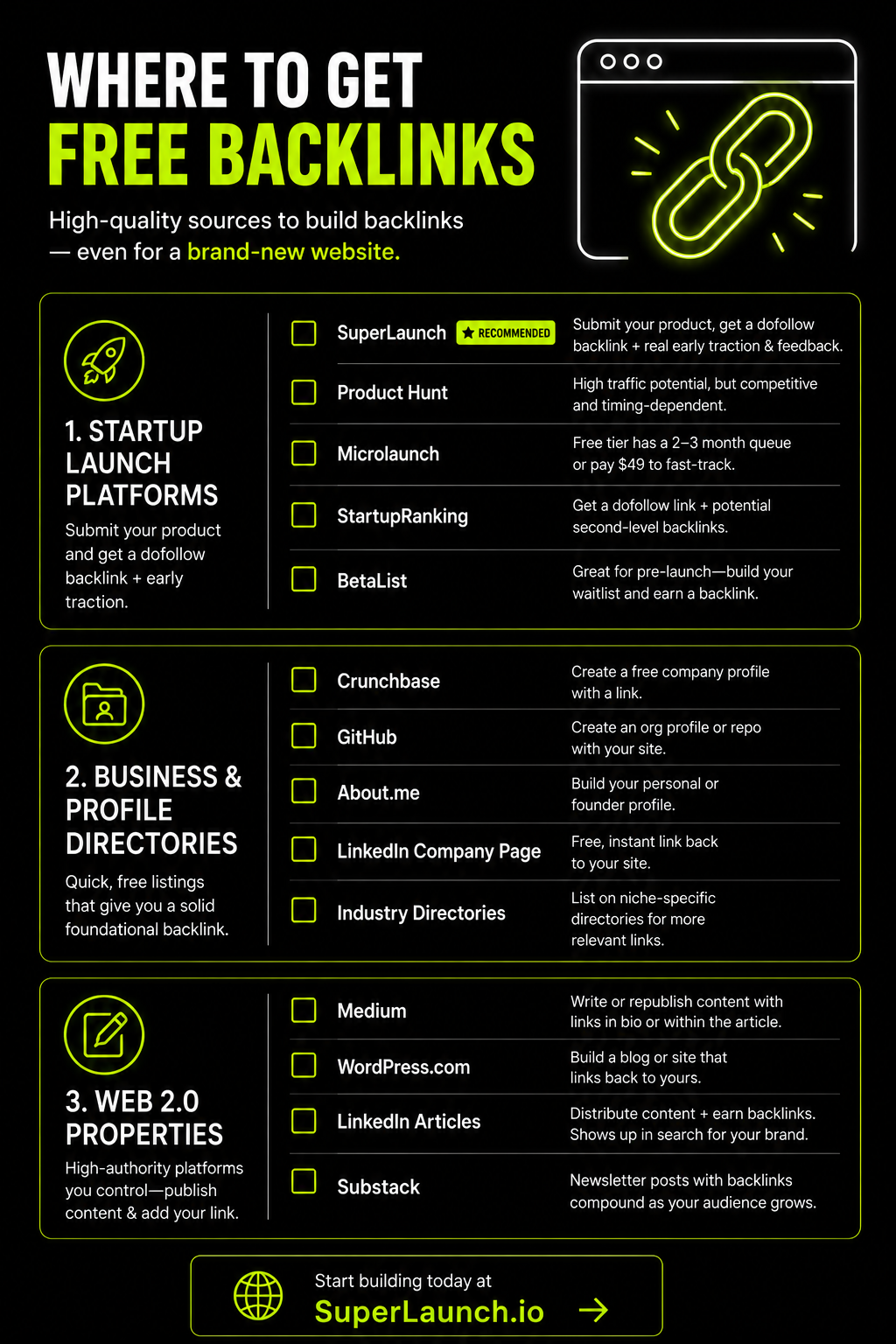
Tier 1: Tactics That Work With Zero Authority
These are the tactics to start with today. They don't require relationships, outreach, or content assets you haven't built yet. Just a URL and a description of what you're building.
Startup Launch Platforms (The Easiest Way to Get Free Backlinks)
If you're launching something new, this is genuinely the lowest-effort, highest-success-rate tactic on this entire list. No pitching, no waiting for a reply, no track record required. You submit your product, and you get a dofollow backlink, often with real traffic and feedback attached.
- SuperLaunch lets you submit your product for launch and get a backlink plus real early traction from the community. This is what sets it apart from a plain directory listing, you get founders actually checking out your product and giving feedback, not just a static link sitting on a page nobody visits.
- Product Hunt has the highest traffic potential of any launch platform, but launch day is competitive and results depend heavily on timing and community support.
- Microlaunch has a 2-3 month queue on the free tier, or you can pay $49 to fast-track your listing.
- StartupRanking gives you a dofollow link, and you can pick up second-level backlinks if other sites reference your listing.
- BetaList works well if you're still pre-launch and want to build an early access list alongside the backlink.
Submit to two or three of these today. It's the single easiest item on this list to knock out before moving into anything that requires outreach.
Also read: Best AI Tool Directories for Backlinks: Where to Submit Your AI Tool
Business and Profile Directories
These won't send much traffic on their own, but they're quick, free, and most give you a real dofollow link tied to your business name. Good for building a foundational backlink profile before you move into anything relationship-based.
- Crunchbase lets you create a free company profile with a link back to your site, and it carries real domain authority
- GitHub works well if your product has any developer angle, create an org profile or repo with your site linked
- About.me is a simple personal or founder profile page, useful if you're building a personal brand alongside the company
- LinkedIn Company Page isn't purely an SEO play, but the link back to your site is free and instant
- Industry-specific directories matter more than generic ones. A directory built for SaaS tools, agencies, or your specific niche carries more relevance than a general business listing site
Web 2.0 Properties
These are free publishing platforms with high domain authority built in. You're not waiting on anyone to approve or link to you, you publish the content yourself and control the link.
- Medium lets you republish or write original content with a link back to your site in your bio or within the article itself
- WordPress.com works well for a more permanent presence, treat it almost like a secondary blog that funnels back to your main site
- LinkedIn Articles double as content distribution to your existing network and a backlink source, and they tend to get picked up in search results for your name or brand
- Substack is worth considering if you're already building an audience, since a newsletter post with a backlink compounds over time as your subscriber base grows
The catch with all of these: don't just drop a link and walk away. A thin, one-paragraph post with a link stuffed in reads as spam, both to readers and to search engines. Write something genuinely useful, even if it's a shorter version of a piece you already have on your site.
Also read: Product Launch Tools: What You Actually Need to Get Users
Tier 2: Relationship-Based Tactics
Once you've got a handful of backlinks from Tier 1, you're ready to move into tactics that need a bit more outreach muscle. These take longer to land, but the links tend to carry more authority and relevance.
Digital PR and Journalist Requests
HARO shut down and was folded into Connectively, so if you're still hearing "just use HARO" as advice, it's outdated. Here's where to go instead:
- Connectively is the direct successor to HARO, same basic model, journalists post requests, you pitch a quote or expert insight
- Qwoted connects sources with journalists across a wider range of publications and beats
- Featured (formerly Terkel) publishes expert answers directly on its own site, so you often get a link even if a journalist never picks up your quote elsewhere
The trick to getting picked as a new founder with no press history: answer fast, keep your response under 100 words, and give a specific, concrete answer instead of generic advice. Journalists are skimming dozens of pitches, and specificity is what gets you chosen over someone with a bigger name but a vaguer quote.
Guest Posting on Niche Blogs
Guest posting works differently when you have zero track record. Skip the big-name publications for now, they won't respond to a cold pitch from an unknown founder. Instead:
- Target smaller, niche blogs in your specific industry, ones actively publishing guest content (check their site for a "write for us" page or recent guest bylines)
- Pitch a specific angle, not just "I'd like to write for you." Reference a gap in their existing content and propose exactly what you'd cover
- Lead with expertise, not your company. The link back to your site should feel earned through the value of the post, not the reason you wrote it
Testimonials and Case Studies
This one's underused and genuinely easy. Think about every tool, software, or service you already use and pay for. Most companies have a testimonials page, and many will link back to your site in exchange for a quote.
- Reach out to 5-10 tools you actually use and offer a short, specific testimonial
- Ask directly if they'll include a link back to your site alongside your name and company
- This works especially well with smaller SaaS companies actively building out their testimonials page, they need the social proof as much as you need the link
Broken Link Building
Find pages on relevant sites that link out to a dead page, then suggest your own content as the replacement.
- Use a free tool like Ahrefs' broken link checker (limited free searches) or Check My Links (Chrome extension) to scan resource pages in your niche
- Reach out to the site owner, point out the broken link specifically, and suggest your page as a working replacement, only if it's genuinely relevant
- Keep the outreach short. Site owners get a lot of link requests, and a two-line email pointing out a real problem on their site gets read faster than a long pitch
Tier 3: Content-Driven Tactics
These take the most upfront work, but they're what actually compound over time. Instead of asking for a link, you build something worth linking to on its own.
Free Tools as Link Bait
A simple, useful free tool tends to earn backlinks passively, people link to it because it solves a problem, not because you asked.
- Doesn't need to be complex. A calculator, a template generator, or a simple checker tool relevant to your niche works
- Embed it on its own page with a clear, linkable URL
- Once it's live, mention it in relevant communities, forums, or your own outreach, since a working tool is an easy yes for someone deciding whether to link to you
Original Research or Small Data Studies
You don't need a massive dataset. Even a small survey of 50-100 people in your niche, or an analysis of your own product usage data, gives journalists and bloggers something concrete to cite.
- Pick one specific, narrow question your audience or industry cares about
- Publish the findings as a standalone page with clear charts or stats pulled out for easy quoting
- Pitch it directly to niche blogs and journalists covering your space, original data is one of the easiest things to get picked up because it saves them research time
Resource Page Link Building
Many niches have curated "resource" or "tools" pages that site owners keep updated and are actively looking to add to.
- Search for
"resources" + your nicheor"useful tools" + your nicheto find these pages - Check that the page is actually maintained (recent updates, working links) before reaching out
- Pitch your page as an addition, explain briefly why it fits, and keep it short
Expert Roundups
Two angles here, and both work.
- Get featured in one. Search for roundup posts in your niche and reach out to be included in future ones. These almost always link back to your site.
- Run your own. Ask 10-15 people in your space one specific question, compile the answers into a post, and every person you feature has a natural reason to share and link to it.
Reclaiming What You Already Have
Before chasing new links, check if you've already earned mentions you haven't converted into backlinks yet.
Unlinked Brand Mentions
People sometimes mention your product or company name without linking to it. That's a link you can often get just by asking.
- Google Alerts is free and will notify you whenever your brand name gets mentioned online
- Mention offers a limited free tier for tracking brand mentions across the web and social platforms
- BuzzSumo can help you find where your content or brand has been referenced
Once you find an unlinked mention, reach out with a short, friendly note. Thank them for the mention, and ask if they'd be willing to link the brand name to your site. Since they already chose to mention you, this is one of the easiest asks in this entire guide, you're not asking for a new favor, just a small edit to something they've already published.
Competitor Backlink Gap Analysis
Your competitors have already done the work of finding sites willing to link out in your niche. Use that.
- Run a competitor's domain through Ahrefs or Semrush's free backlink checker
- Look for patterns, directories, guest post sites, roundups, or resource pages that link to multiple competitors but not you
- If a site links to two or three of your competitors, it's a strong signal they'll link to you too. Reach out with the same tactics covered in Tier 2 or 3, depending on what kind of link it is
What to Avoid
Not every backlink helps you. Some actively hurt your rankings, and it's worth knowing which ones before you spend time chasing them.
- Paid link schemes disguised as "free." Some sites offer a free listing but push you toward a paid tier for a dofollow link or better placement. If the model is pay-to-play, it's a link scheme, not a backlink strategy.
- Low-quality directory spam. Submitting to hundreds of generic directories with no real traffic or editorial standards does more harm than good. Google can identify these patterns, and a backlink profile full of them looks manipulative rather than earned.
- PBNs (private blog networks). These are networks of sites built specifically to link to each other and manipulate rankings. They're against Google's guidelines, and getting caught can mean a manual penalty that's difficult to recover from.
- Reciprocal link exchanges at scale. A one-off "I'll link to you if you link to me" with a genuinely relevant site isn't a huge risk. Doing this systematically across dozens of sites is a pattern Google actively looks for.
The short version: if a tactic feels like it's gaming the system rather than earning a link on merit, it probably is. Google's own guidance has gotten more direct about this over time, and manual penalties for manipulative link building are hard to undo.
Wrapping Up
Getting your first backlinks doesn't have to mean chasing agencies or waiting months for a journalist to notice you exist. Start with the tactics that need nothing but your URL, startup launch platforms like SuperLaunch, directories, and web 2.0 profiles. Once you've got a handful of links and some real content on your site, move into outreach and content-driven tactics that compound over time.
The data is clear on why this matters. A site with even one backlink outperforms one with none by a wide margin. You don't need a massive link profile to start seeing results, you just need to get off zero.
Pick two or three tactics from Tier 1 and knock them out today. Everything else on this list gets easier once your site has a foundation to build on.
FAQ-
Is buying backlinks illegal?
No, it's not illegal, but it violates Google's Webmaster Guidelines. Buying links specifically to manipulate rankings can get your site hit with a manual penalty, which is far more damaging than any short-term ranking boost you'd get from the purchased links.
Can AI create backlinks?
Not directly. AI tools can help you find link opportunities faster, draft outreach emails, or generate content that earns links naturally, but no AI tool can hand you a real backlink. Every link still needs another site owner to actually place it.
Where can I submit free backlinks?
Start with startup launch platforms like SuperLaunch and Product Hunt, business directories like Crunchbase, and web 2.0 platforms like Medium. All of these let you submit and get a link without waiting on anyone's approval.
How do you actually build backlinks?
Start with low-effort, no-relationship tactics like directories and launch platforms. Once you have a handful of links, move into outreach-based tactics like guest posts and testimonials. Once you have some content worth linking to, focus on earning links passively through free tools, original research, or resource page listings.
How many backlinks does a new website need?
There's no fixed number. What matters more is relevance and referring domain diversity. A handful of links from sites actually in your niche will outperform hundreds from unrelated or low-quality sources.