Why SaaS Customers Churn (And It’s Usually Not the Price)

There’s a specific kind of silence that Karanvir remembers from an early conversation with a founder. The kind that falls after a hard question lands and there’s no good answer.
The founder had just lost his tenth customer that month. He was frustrated — understandably so — but what caught Karanvir’s attention wasn’t the frustration. It was the honesty that followed.
“He told me he thought it was pricing,” Karanvir recalls. “But when I asked if he’d looked at their support tickets, their login frequency, how many features they’d activated before cancelling — he went quiet.”
All that information existed. It was sitting in Stripe, in Intercom, in his analytics tool. Nobody had connected it.
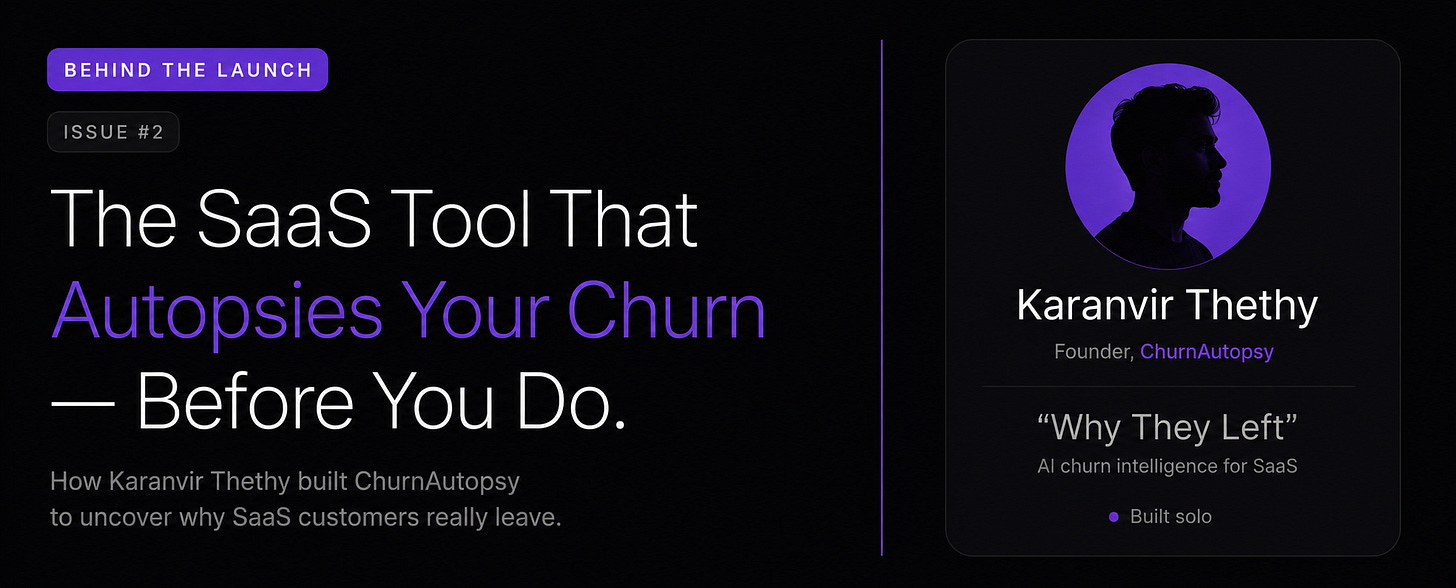
That conversation became the seed of ChurnAutopsy. But first, Karanvir had to ask the same question to every SaaS founder he could find.
The Exit Survey Lie
The answer he kept getting back was consistent: no, they didn’t really know why their customers were leaving.
It wasn’t that the data didn’t exist. It was that until recently, AI wasn’t capable enough to read all that fragmented context together and produce something genuinely useful. “That window opened,” Karanvir says simply, “and I walked through it.”
He looked at what founders were doing when a customer churned and found three camps. The most diligent ones were doing it manually — opening Stripe in one tab, Intercom in another, trying to piece together a story. Effective, but completely unsustainable past 20 or 30 churns a month. The majority were reading the exit survey and filing it. And the third group wasn’t doing anything at all — just absorbing the Stripe notification, feeling a moment of frustration, and moving on. The knowledge of why that customer left would simply disappear.
Every Sunday, Behind the Launch tells the story of one founder building something real. No press releases. No polished narratives. Just the honest version.
Version One
The first version of ChurnAutopsy was, by Karanvir’s own admission, almost embarrassingly simple. You uploaded a CSV of churned customers, and the AI read everything together and gave you a plain-English explanation of why each one left. No integrations. No automation. Just: here’s what it means.
What he didn’t expect was the reaction.
That sentence told him the core idea was right.
What changed the product significantly came from watching early users. Founders didn’t just want to understand one customer in isolation — they wanted to know if there was a pattern. When you look at 20 churned customers and find that 15 of them hit the same friction point in week two, that’s not a one-off. That’s a product problem you can actually fix. The pattern detection feature — now the most strategically valuable part of the product — was never in the original plan. It emerged entirely from watching what founders were trying to do that the product wasn’t letting them do.
The Real Culprit
After running hundreds of churned customers through the product, a pattern emerged so consistently that Karanvir gave it a name: silent onboarding failure.
The story goes like this. A customer signs up with genuine intent. They hit a point of confusion in the first two weeks — something not obvious enough, a feature that requires unexpected setup, an integration that doesn’t work the way they assumed. They open a support ticket, or sometimes don’t even do that. They log in a few more times, trying to make it work, doing so less frequently. They’re not angry. They haven’t decided to leave. They just quietly drift, until one day they look at their credit card statement and cancel.
This pattern shows up in roughly 65–70% of the churned customers ChurnAutopsy analyses. And almost none of them report it as the reason they left.
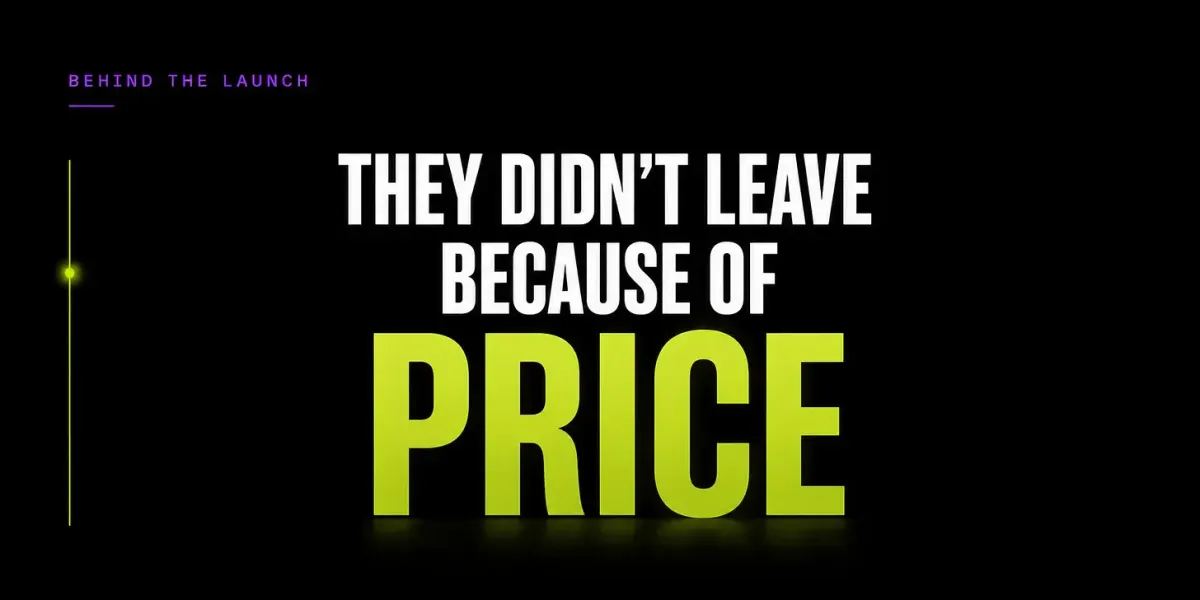
The case that crystallised this came from a B2B analytics founder who was convinced his churn was a pricing problem. He’d done the maths, looked at the exit surveys, talked to former customers, and landed on the conclusion that he was priced 20–30% too high. He was about to run a repricing exercise.
When they ran his last 10 churned customers through ChurnAutopsy, 8 of them had opened a support ticket in weeks two or three asking about a specific data integration. All 8 received a link to documentation. None of them ever successfully completed the integration. Their login frequency dropped sharply the week after that support ticket. They all cancelled within 60 days. And all of them selected “too expensive” on the way out.
The integration worked fine. It just required a step that wasn’t obvious. One confusing moment in week two was silently killing 80% of his churned customers, and none of them had consciously registered it as the reason they left.
He fixed the onboarding for that integration. He never changed his pricing.
The Silence Nobody Talks About
Building ChurnAutopsy wasn’t without its own difficult period. Karanvir is candid about the early months.
“You’re posting, you’re reaching out to founders, you’re building, and the response is mostly nothing,” he says. “The ratio of effort to visible progress is demoralising in a way that’s hard to describe unless you’ve been through it.”
What kept him going was a deliberate decision to focus on conversations over metrics. Even when people weren’t ready to pay, he kept hearing versions of the same thing: this is a real problem, I just haven’t found the right solution yet. That consistent signal from people who understood the space was enough.
The moment that fully shifted it: a founder used a demo on his actual churned customer data and immediately said he’d been about to lower his prices to fix a churn problem that was actually caused by a confusing integration setup. He’d been ready to give away revenue to solve the wrong problem. One conversation made everything before it feel worth it.
There’s a harder truth Karanvir has come to about the early-stage building experience that he wishes someone had told him before he started.
“What nobody says publicly is that the silence is just how it works,” he says. “It’s not a sign you should pivot or give up. It’s the normal experience of building something that doesn’t have distribution yet. The founders who make it through this period aren’t the ones who avoided it. They’re the ones who found a way to keep showing up during it without requiring external validation to do so.”
What’s Next
In 12 months, Karanvir wants ChurnAutopsy to feel less like a tool and more like a team member — the one who’s always watching your retention data so you don’t have to. Connect Stripe once. Get an autopsy report within 60 seconds of every cancellation. Get a Monday morning digest of churn patterns and at-risk customers without ever logging in.
The target customer is the SaaS company in the £10K to £500K MRR range — too serious about retention to keep guessing, but not yet ready for Gainsight’s enterprise pricing and complexity.
The bar he’s set for himself is specific: a founder should be able to say they haven’t lost a customer they didn’t understand in six months. Not just knowing why customers leave — knowing early enough to do something about it.
And for any founder reading this who just lost their first five customers and has no idea why, his advice is equally direct.
Fix that one thing, he says. Don’t reprice. Don’t rebuild features. Don’t run win-back campaigns. Understand what specifically broke in the first month, and fix it.
The answer has been there all along. You just needed someone to connect the dots.
Visit superlaunch.io to submit your product or join the reviewer community.